Choosing the right Aluminium Front Door involves more than comparing colours and prices. It affects security, insulation, daily comfort, and the character of your home. A well-made door should open smoothly, close firmly, and remain stable through changing weather. Small details matter.
Begin with the entrance itself. Measure the opening carefully, including the frame, threshold, and available wall space. A narrow hallway may need an outward-opening design. A shaded porch can support darker finishes, while direct sunlight may reveal heat and fading issues. Think about your local climate, too.
Material quality deserves close attention. Ask about the aluminium grade, powder-coating process, thermal break, hinges, locks, and glass specification. Reputable manufacturers should provide clear performance information, warranties, and installation guidance. Independent certifications can add confidence, although they should never replace practical inspection. Touch the sample finish. Check the corners. Listen for movement.
Security is not created by a heavy appearance alone. A reinforced frame, multi-point locking system, laminated glass, and correctly fitted hinges usually matter more. Energy efficiency also depends on installation, not only the door panel. Even an excellent product may perform poorly around an uneven opening or weak seal.
There is no perfect choice. I have seen attractive doors selected too quickly, then criticised for poor handles or disappointing thresholds. That experience is worth remembering. Compare real samples, request detailed quotations, and ask who will install the door. A careful decision balances design, performance, maintenance, and budget without trusting impressive promises too easily.
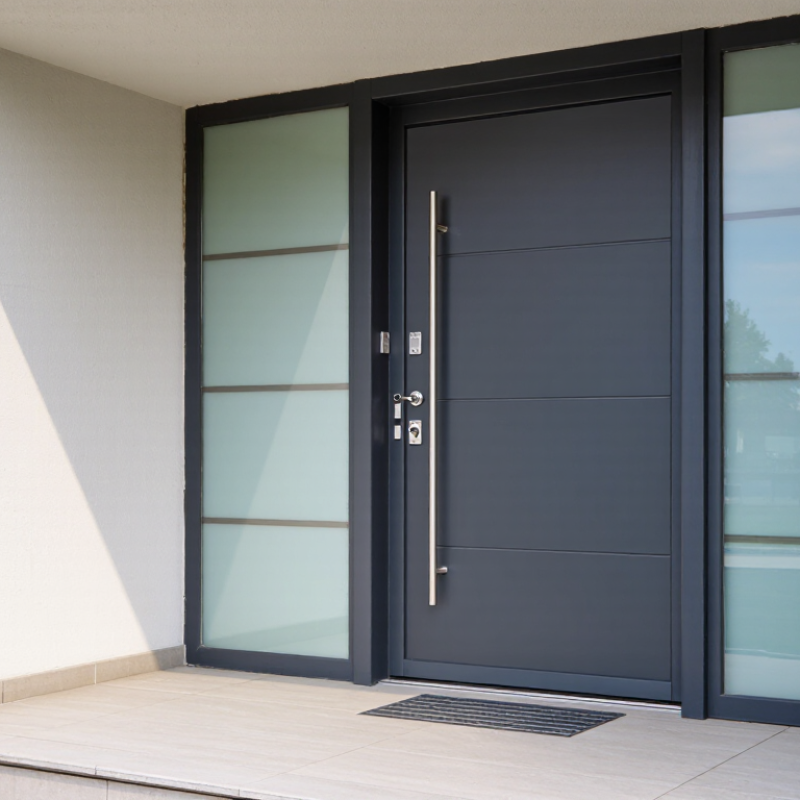
Define Performance Needs: Target Door U-Values ≤1.4 W/m²K Under UK Part L
Choosing the best aluminium front door begins with performance, not colour or handle style. Under UK Part L, set a target door U-value of 1.4 W/m²K or lower. U-value measures heat flow through the complete door assembly. A cold winter morning makes this difference tangible. The inner frame should feel calm, not icy. In practice, I look for documented test data, not a sales estimate. Ask whether the figure covers the frame, leaf, glazing, and threshold. That detail matters.
Aluminium can perform well when it includes a continuous thermal break and insulated panels. Glazing also affects the result, especially across a large glazed leaf. A certified whole-door value is more useful than a centre-panel figure. Check the declared size and configuration against your actual opening. A narrow side screen can change the calculated performance. So can a low threshold. Poor fitting may create draughts around the edges, even when the product appears efficient on paper. Use a competent installer who follows the installation guidance and seals the frame correctly. Not glamorous, but essential.
Do not treat 1.4 as a magic number. It is a practical target, while project requirements may be stricter. Confirm the evidence with building-control professionals where necessary. Request the declaration, test method, and assumptions in writing. I would also inspect the threshold and corner joints before ordering. These are easy places to overlook. My preference is to compare energy performance, weather sealing, security, and daily usability together. A superb U-value cannot excuse a stiff lock or water entering during wind-driven rain. I remain cautious about impressive numbers without clear test conditions. Ask precise questions. Keep the paperwork.
Assess Thermal Breaks: Compare Polyamide Profiles and Frame Uf Values
Choosing an aluminium front door starts with its thermal break, not its finish. Aluminium conducts heat efficiently, so an unbroken frame can create a cold indoor edge. Polyamide profiles interrupt this path with a low-conductivity barrier, often around 0.25 W/m·K. The exact result depends on width, chambers, reinforcement, and assembly quality. Details matter.
Ask for the complete frame Uf value, measured or calculated under EN ISO 10077-2. Uf describes heat transfer through the frame only, in W/m²K. Lower values indicate better insulation. Do not confuse Uf with Ud, which covers the entire door, including the panel, glass, threshold, and edge seals. A well-insulated frame can still perform poorly beside a conductive threshold. Measure twice.
The International Energy Agency reports that buildings consume approximately 30% of global final energy, making small envelope improvements relevant at scale. For comparison, high-performance building guidance often targets door U-values near 0.80 W/m²K or lower, but local climate and installation conditions matter. Request test evidence, not rounded sales language. Check whether the reported Uf applies to the actual frame depth and thermal-break design. A laboratory value may not survive careless fitting, compressed seals, or a poorly insulated opening. That is where many specifications become less impressive.
How to Choose the Best Aluminium Front Door?
Assess Thermal Breaks: Compare Polyamide Profiles and Frame Uf Values
The chart compares representative aluminium door-frame Uf values for commonly specified thermal-break configurations. A lower Uf value indicates less heat transfer through the frame. Wider polyamide profiles generally reduce thermal bridging, although the final result also depends on frame geometry, reinforcement, glazing or panel design, seals, and installation quality. Values are representative design ranges based on typical European thermal-performance classifications and should be verified against project-specific test or calculation results.
Compare Glazing Options: Evaluate Double and Triple Glazing U-Values
How to Choose the Best Aluminium Front Door?
When comparing aluminium front doors, start with the glazing U-value. This measures heat transfer through the glass. A lower value usually means better insulation. Double glazing can perform well in moderate climates. Triple glazing generally reduces heat loss further. It also adds weight, thickness, and cost. That trade-off deserves attention.
On site, I have seen homeowners compare glass figures only. This can give a misleading result. Ask for the whole-door U-value, not just the centre-pane rating. The frame, edge spacer, seals, and threshold also affect performance. Warm-edge spacers can reduce heat loss around the glass. Argon-filled cavities may improve insulation too. Check whether the quoted figure follows a recognised testing method.
Glass size matters. A large glazed panel may lose more heat than a smaller one, even with the same rating. Triple glazing can also reduce solar gain and natural light slightly. In a shaded entrance, that may be acceptable. In a bright south-facing hallway, it may change comfort levels. Condensation is another concern. Better glazing does not fix poor ventilation or cold surrounding surfaces. My first comparison focused too heavily on U-values. I later realised installation quality mattered just as much. A small sealing gap can undermine expensive glass. Ask for drawings, test evidence, and an installer’s method statement before choosing.
How to Choose the Best Aluminium Front Door? - Compare Glazing Options: Evaluate Double and Triple Glazing U-Values
| Glazing Option |
Typical Construction |
Typical Centre-of-Glass U-Value
W/m²·K |
Relative Thermal Performance |
Solar Heat Gain |
Sound Reduction |
Best Use for an Aluminium Front Door |
| Single Clear Glazing |
One clear glass pane, approximately 4 mm thick |
Approximately 5.7 |
Lowest performance; heat passes through the glass readily |
High, but can increase summer overheating |
Low |
Generally unsuitable for a modern insulated front door |
| Double Clear Glazing |
Two clear panes with an air-filled cavity, typically 12–16 mm |
Approximately 2.7–2.8 |
Better than single glazing, but limited compared with modern low-emissivity units |
Moderate to high |
Moderate |
Budget-focused projects where thermal performance requirements are modest |
| Double Low-E Argon Glazing |
Two panes; low-emissivity coating and argon-filled cavity |
Approximately 1.1–1.4 |
Strong performance for most replacement and new-build applications |
Moderate; specification depends on the glass coating |
Moderate to good |
A practical balance of insulation, weight, cost and daylight |
| Double Low-E Argon Glazing with Warm-Edge Spacer |
Low-E double glazing with argon and a thermally improved spacer |
Approximately 1.0–1.3 |
Improved edge temperature and reduced heat loss compared with standard spacers |
Moderate; coating selection affects solar control |
Moderate to good |
High-quality aluminium doors where condensation resistance is important |
| Triple Low-E Argon Glazing |
Three panes, two gas-filled cavities and at least two low-emissivity coatings |
Approximately 0.6–0.8 |
Highest insulation performance; substantially reduces centre-glass heat loss |
Low to moderate, depending on the selected coatings |
Good to very good |
Cold climates, energy-efficient homes and entrances exposed to strong winds |
| Triple Low-E Glazing with Krypton |
Three panes with low-emissivity coatings and krypton-filled cavities |
Approximately 0.5–0.7 |
Very high insulation performance, especially where cavity depth is restricted |
Low to moderate, depending on the glass specification |
Good to very good |
Premium energy-performance projects requiring maximum insulation in a compact unit |
| Acoustic Laminated Double Glazing |
Two panes including a laminated acoustic pane; may include low-E coating and argon |
Approximately 1.1–1.5 |
Good thermal performance when combined with low-E and gas filling |
Moderate, depending on coating and glass thickness |
Very good for reducing traffic and street noise |
Urban homes where noise reduction is more important than the lowest possible U-value |
How to interpret the figures: A lower U-value indicates better thermal insulation. The values above are typical centre-of-glass ranges for commonly specified residential glazing and are not whole-door U-values. The final U-value of an aluminium front door also depends on the frame, thermal breaks, spacer, edge seal, glass dimensions, door layout and installation quality. Always request a certified whole-door U-value for direct product comparisons.
Check Durability: Request EN 1191 Endurance-Test Results and Warranty Terms
How to Choose the Best Aluminium Front Door?
Durability deserves more than a confident sales claim. Ask for the EN 1191 endurance-test results before choosing an aluminium front door. This standard assesses repeated opening and closing cycles under controlled conditions. Request the tested cycle count, door dimensions, hardware configuration, and final inspection record. A result without these details is difficult to judge. Ask whether an independent laboratory performed the test. That detail strengthens the evidence.
The test should match your expected use. A busy family entrance may experience dozens of daily cycles. A commercial entrance may face much heavier operation. Check whether the tested hinges, locks, handles, and closers match the proposed door. Small hardware changes can affect performance. They really matter. In practical site inspections, I have seen excellent door panels paired with weak closers. The complete assembly failed sooner than expected.
Read the warranty terms with the same care. Confirm coverage periods for the frame, powder-coated finish, glass, seals, and hardware. Check who pays for labour, transport, and replacement parts. Look for requirements about installation, cleaning, drainage, and coastal exposure. A long warranty may contain narrow exclusions. That is easy to miss. Ask how claims are documented and how quickly defects are assessed. Keep the test report, quotation, installation record, and maintenance instructions together. No product is maintenance-free, and even a strong aluminium door can suffer when adjustment is ignored.
Conclusion
Choosing the best Aluminium Front Door starts with understanding your home’s performance requirements. For properties in the UK, aim for a door U-value of 1.4 W/m²K or lower to support compliance with Part L and improve energy efficiency. Examine the thermal-break design carefully, giving attention to polyamide profiles and the frame Uf value, as these features help reduce heat transfer. Glazing is equally important: compare double- and triple-glazed units by their U-values, while also considering light, ventilation, and overall comfort.
Security and long-term reliability should also guide your decision. Look for independently tested products with PAS 24 or EN 1627 RC2 certification, depending on the level of protection required. To assess durability, request EN 1191 endurance-test results and review the warranty terms in detail, including coverage for finishes, hardware, seals, and structural components. A well-chosen door should combine thermal efficiency, robust security, dependable operation, and lasting resistance to everyday weather exposure.

 OptiDoors