How to Choose a Premium Aluminum Entry Door?

Time:2026-11-08 Author:Henry
0%

Choosing a Premium Aluminum Entry Door involves more than comparing finishes. The door must feel solid, close smoothly, and seal tightly around its frame. On a cold morning, even a narrow gap can bring a noticeable draft. The U.S. Department of Energy’s Energy Saver guidance recommends considering insulation, weatherstripping, and air leakage when selecting exterior doors. Those details matter as much as a striking handle or dark powder-coated surface.

Cost and resale data can help set expectations, but they need careful reading. Zonda’s 2024 Cost vs. Value report estimated that steel entry door replacement recouped about 188% of project cost in its U.S. averages. That figure applies to steel doors, not aluminum, and it is not a promise of future resale value. Still, it shows why entry-door upgrades receive attention in renovation planning. A useful benchmark, not a guarantee.

For aluminum, compare the complete system: frame, thermal break, glazing, seals, hardware, and finish. Ask for documented performance ratings, such as U-factor and air-leakage results, and check whether they apply to the exact door configuration. A glass insert may brighten a shaded foyer, but it can change privacy, maintenance, and thermal performance. Look closely at installation details, too; a premium slab cannot correct a poorly sealed opening. And yes, specifications can feel tedious. They are also where confident marketing claims become verifiable choices.
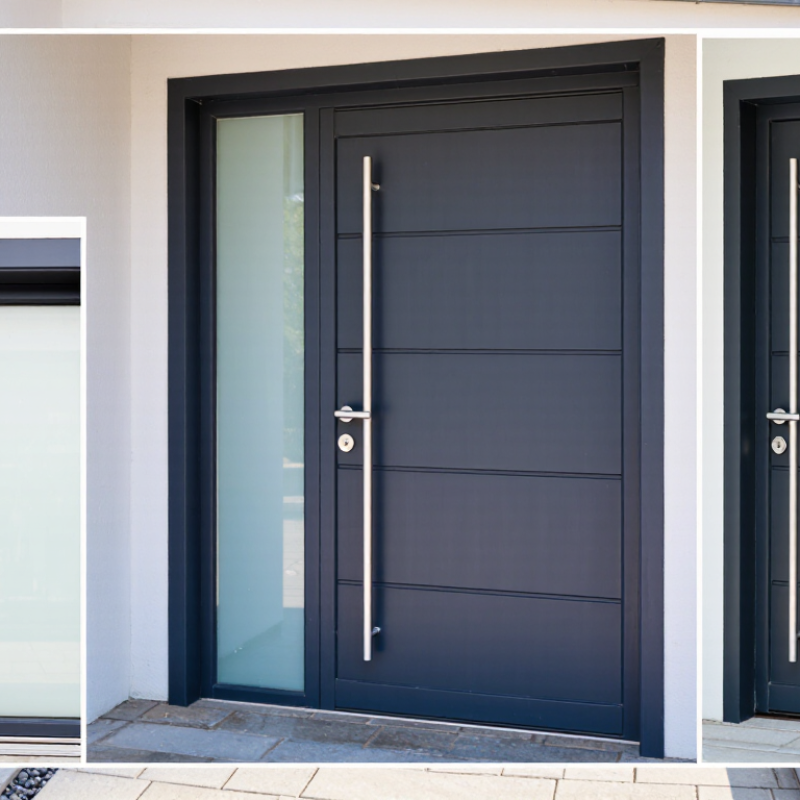
How to Choose a Premium Aluminum Entry Door?

Define Climate Requirements with NFRC U-Factor and SHGC Ratings

NFRC ratings make entry doors easier to compare under consistent test conditions. U-factor measures how quickly heat passes through the complete door assembly. Lower values generally mean better insulation. That matters on a cold, windy evening when the inside face of a poorly insulated door feels chilly. Check the rating for the entire unit, not just its glass. Small details matter.

SHGC measures how much solar heat enters through the door’s glazing. A lower rating can help limit unwanted heat in sunny, warm climates, especially on west-facing entrances that catch strong afternoon sun. In colder regions, some solar gain may be useful during winter. There is no single ideal number for every home. Orientation matters.

Compare both ratings with your local climate and the door’s placement. A shaded north-facing entry may have different needs from a sunlit southern exposure. If possible, review the NFRC label alongside the manufacturer’s installation details and your home’s insulation conditions. Aluminum frames can conduct heat, so ask whether the design includes a thermal break; the ratings still describe the tested assembly. I would not choose by rating alone. Air leakage, weatherstripping, and careful installation affect comfort too, and a good label cannot fix a poor fit.

Compare Whole-Door U-Factor in Btu/h·ft²·°F, Not Frame Claims Alone

When comparing premium aluminum entry doors, ask for the whole-door U-factor, not a frame-only figure. This value estimates heat transfer through the assembled unit, including its slab, frame, glazing, and edges. Lower values generally mean less heat passes through under the stated test conditions. Small difference? It may matter over a cold season, but one number cannot predict every home’s energy use.

Check the units: Btu/h·ft²·°F. Then confirm competing figures use the same test method, door size, glass layout, and configuration. A glazed model may perform differently from an opaque one. Ask for a test report or rating label covering the exact configuration you are considering. Some product sheets feature center-of-panel results. That is not the whole door.

Insulated cores and thermal breaks can reduce heat flow through aluminum. Still, installation matters. A well-rated door may lose performance around a poorly sealed threshold or uneven jamb. Check the weatherstripping and sill, and notice drafts near the latch on a windy day. U-factor does not measure air leakage, so request that figure separately. There is no perfect shortcut; the published value cannot show how carefully the door will be fitted.

How to Choose a Premium Aluminum Entry Door?

Compare Whole-Door U-Factor in Btu/h·ft²·°F, Not Frame Claims Alone

These are calculated examples, not product ratings. Heat loss is estimated as U-factor × door area × temperature difference, using a 21 ft² door and a 50°F temperature difference. Lower U-factor means less heat transfer. When comparing doors, check the certified whole-door U-factor; a frame-only figure does not represent the complete door.

Check Air Leakage at ASTM E283’s 1.57-psf Test Pressure

A premium aluminum entry door should be judged by its tested air leakage, not by frame weight or a tight-looking showroom display. ASTM E283 measures airflow through a complete assembly under a controlled pressure difference. At 1.57 psf, or 75 Pa, the report should state leakage in cubic feet per minute per square foot (cfm/ft²). Ask for the test result, specimen size, and details of the frame, threshold, seals, and hardware. Small gaps matter.

For context, the 2021 International Energy Conservation Code sets a maximum air-leakage rate of 0.3 cfm/ft² for swinging doors tested at 1.57 psf, using ASTM E283. A lower result may offer a tighter benchmark, but it does not guarantee identical performance after installation.

Check whether the tested door matches the model and configuration you plan to buy. A sill that looks neat can still leak if it is poorly aligned. I would also question any sales sheet that gives a number without naming the test pressure or method; that omission makes comparison difficult. The lab result is useful, but installation quality deserves equal scrutiny.

Match NAFS R, LC, CW, or AW Class to Local Wind and Water Exposure

A premium aluminum entry door should be selected for the weather it will face, not just its finish. NAFS performance classes offer a useful starting point: R is intended for residential buildings, LC for light commercial use, CW for larger or more demanding commercial applications, and AW for architectural projects with higher performance expectations. The class describes a tested performance level, not a guarantee against every storm.

Look beyond the class name. Check the door’s design pressure, water-penetration rating, and air-leakage results against local code requirements and site exposure. A sheltered suburban entrance may face different demands from a doorway exposed to coastal gusts or wind-driven rain. Ask a qualified supplier or designer to confirm the required ratings for the opening size and installation details. Small gaps matter.

Water can find them. Threshold height, sill drainage, flashing, and the connection between the frame and wall all affect real-world performance. A high-rated door installed poorly may still leak, and a robust class can be unnecessary for a protected location. That part is easy to overlook. Compare documented test results for the complete door assembly, then consider maintenance, hardware, and daily use. The right choice depends on the opening, exposure, and installation—not aluminum alone.

Verify Aluminum Alloy, Thermal Breaks, and Multi-Point Lock Specifications

A premium aluminum entry door should come with a traceable alloy specification, not just a “heavy-duty” claim. Ask for the alloy and temper, frame and panel thicknesses, and finish warranty. These details help you judge stiffness and corrosion resistance. A thermal break is equally important. It separates the exterior and interior aluminum sections with a low-conductivity material, reducing heat transfer through the frame. Look for a whole-door U-factor from an NFRC-certified rating, rather than relying on glass-only figures. Small details matter.

The U.S. Department of Energy’s Energy Saver guidance estimates that windows account for about 25–30% of residential heating and cooling energy use. That figure is not a door-specific estimate, but it shows why weak points in a home’s thermal envelope deserve attention. Check the door’s perimeter seals, threshold, and installation details alongside its thermal rating. A good frame can still underperform if cold air slips beneath the sill.

For security, ask how the multi-point lock engages the head, jamb, and sill, and whether the keeps are reinforced into the frame. Request test documentation for the complete door assembly, including the lock, hinges, and strike areas; a lock component’s rating alone tells only part of the story. Ask about the cylinder, service access, and replacement parts, too. I would still inspect a sample in person. Smooth operation is easy to overlook on a specification sheet.

FAQS

What does a door’s U-factor tell me?

It estimates heat transfer through the complete door assembly. Lower values generally mean better insulation. Check the whole unit.

Why should I compare the whole-door rating instead of the frame alone?

The whole-door figure includes the slab, frame, glazing, and edges. A frame-only number misses important heat-transfer paths.

What is SHGC, and does a lower rating always suit my home?

SHGC measures solar heat entering through the glazing. Lower values can help on sunny, warm exposures. In colder regions, winter sun may be useful.

How do I compare ratings from different door configurations?

Check that the test method, door size, glass layout, and configuration match. Ask for documentation on the exact model. Small differences can mislead.

What does a thermal break do in an aluminum door?

It separates interior and exterior aluminum with a low-conductivity material. This can reduce heat flow through the frame, but installation still matters.

Can a strong U-factor rating guarantee a draft-free entry?

No. U-factor does not measure air leakage. Check the weatherstripping, threshold, and jamb for gaps, especially on a windy day.

Which aluminum construction details should I request?

Ask for the alloy, temper, frame and panel thicknesses, and finish warranty. “Heavy-duty” alone is vague. I would want specifics.

What should I check about a multi-point lock?

Ask where it engages and whether the keeps are reinforced into the frame. Request test documentation for the complete assembly, including hinges and strike areas. A sample inspection may still reveal details a sheet misses.

Conclusion

Choosing a Premium Aluminum Entry Door starts with understanding the climate it will face. Use NFRC U-factor ratings to compare heat transfer and SHGC ratings to assess how much solar heat passes through the door. These values help you prioritize insulation or solar control according to local temperatures and sun exposure. Compare the whole-door U-factor, measured in Btu/h·ft²·°F, rather than relying on claims about the frame alone, since the complete assembly affects energy performance.

Next, evaluate durability and security as a system. Check air-leakage results tested under ASTM E283 at 1.57 psf, and match the door’s NAFS performance class—R, LC, CW, or AW—to expected wind and water exposure. Confirm the aluminum alloy, inspect the thermal-break design, and review the multi-point locking specifications. Together, these checks help you select a door that balances efficiency, weather resistance, structural performance, and everyday security.

Henry

Henry

Henry is a dedicated marketing professional with a profound expertise in the company's offerings. With years of experience in the industry, he possesses an impressive understanding of the market dynamics and consumer behaviors that drive success. Henry is committed to sharing his insights through......